Power Within Range
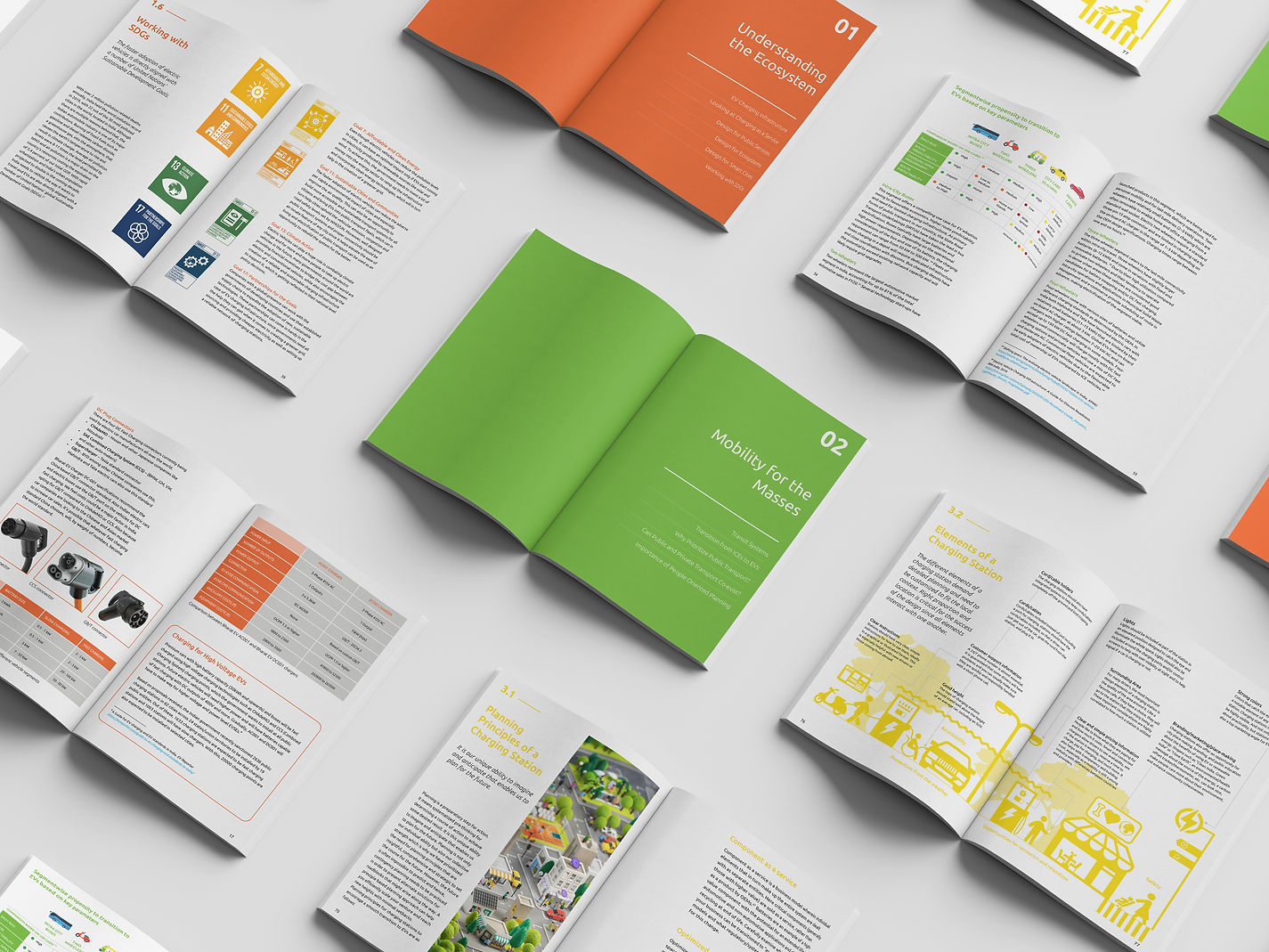
Our Toolkit, Power Within Range, aims to empower the readers to establish their own charging stations by compiling guidelines and strategies regarding setting up and running an EV charging service, in the form of a roadmap that can act as a starting point for their individual projects. The Toolkit includes case studies from the Indian context and identifies stakeholders in the EV ecosystem to facilitate collaboration. Context analysis, phasing, budgeting, and impact evaluation tools are a few of its features. We have also divided the Toolkit into distinct sections so that readers are free to navigate through the resource as per their preferences.
Design Brief
The future of mobility is going the EV way. The world has already started adopting electricity as a power source and has also developed infrastructure to support large scale deployment of EVs. India, on the other hand has as usual taken time to adopt and adapt. There have been several attempts at this in the recent past, however the inevitable tipping point is yet to happen. Havells, whose genesis started with manufacturing electrical cabling and subsequently appliances, sees this as an opportunity area for developing infrastructure, EV charging stations for a variety of vehicles such as rickshaws, two wheelers, buses and cars. Without this infrastructure in place the EV revolution would not be able to take off. This project is about understanding and envisioning an Indian approach to developing an EV infrastructure that is both sustainable and resilient.
Ecosystem Map
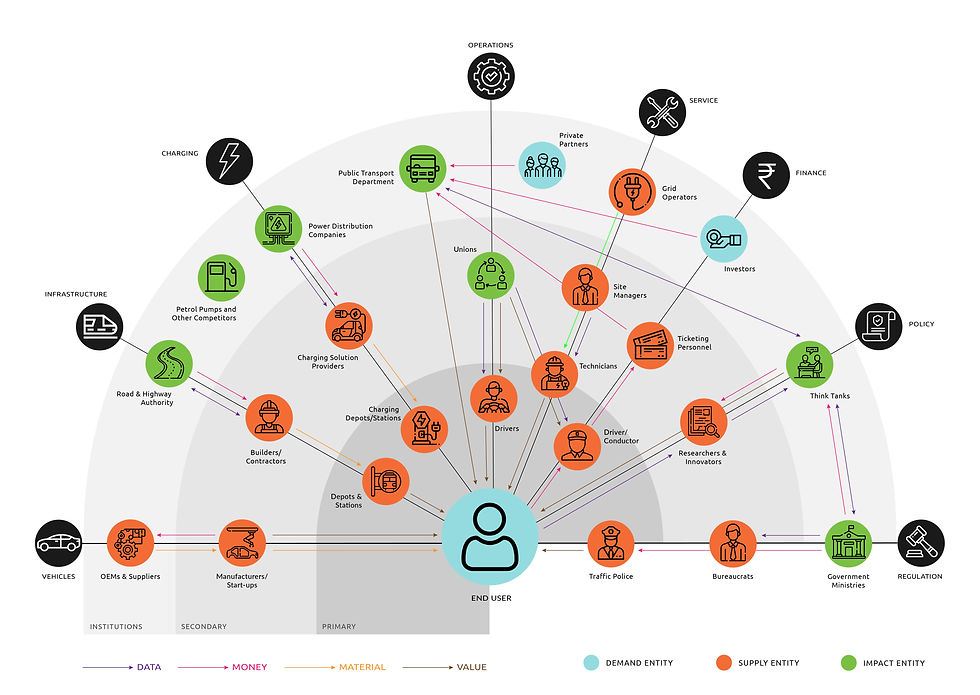
Creating an Ecosystem Map was a crucial step in our design process. An 'ecosystem' can be defined as a network of interconnected elements and the first step to understand such a network is by listing down all the entities, which includes key ecosystem players, allied or adjacent players and additional influencers. The next major task is to recognise the interaction dynamics among these entities and the last step is to identify the value exchanges, both monetary and non-monetary. Another thing to keep in mind is that an ecosystem map is dynamic in nature and it evolves as one's understanding of the subject broadens. In this project, we started by making an ecosystem map for the existing public transport infrastructure which then helped us build an ecosystem map for a potential electrified public transport system.

Affinity Mapping
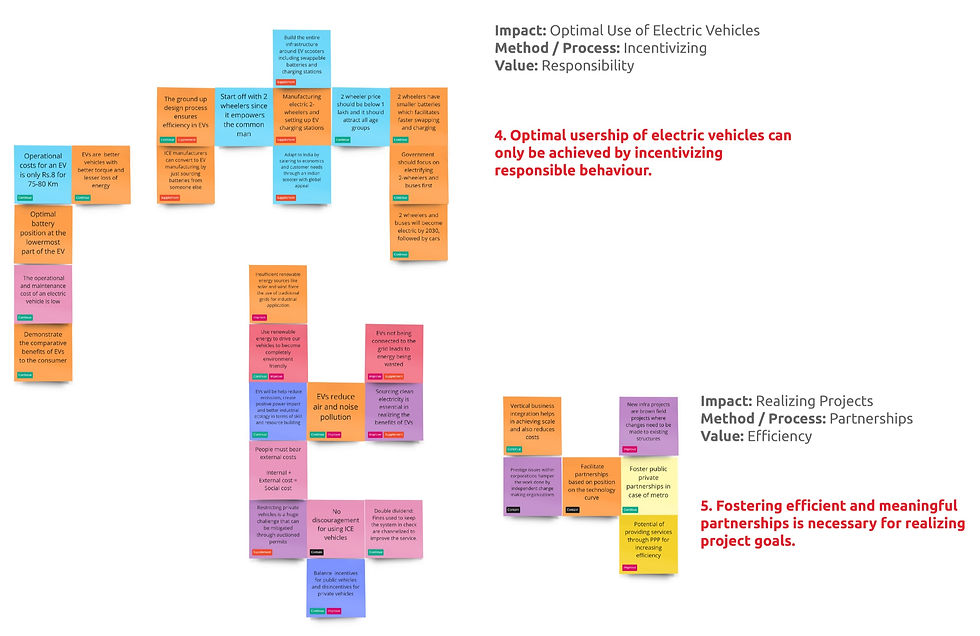
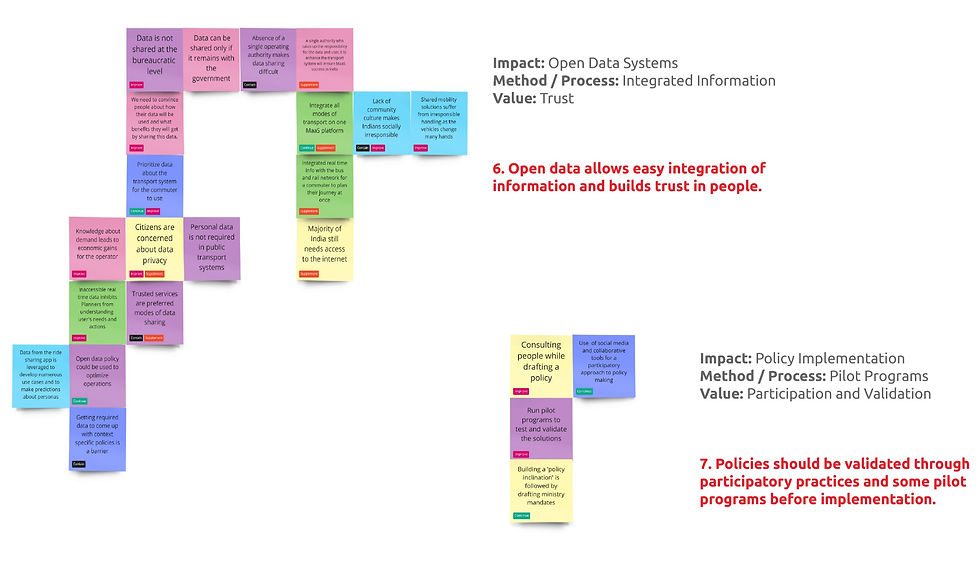
In order to generate actionable insights from all the research that could help during ideation, we decided to use an Affinity Map, which is a tool that helps gather large amounts of data and organise them into groups and themes based on their mutual relationships. This process is great for grouping simple observations or data collected during primary interviews.
It always starts by breaking down the information into smaller bits. One can then draw connections between these individual elements to join the dots and develop new and deeper insights. These might help define the problem(s) and develop potential ideas for solutions. In other words this exercise helps a designer to move from analysis to synthesis. We used Miro for this activity and the findings from our expert interviews were written down on separate post-its and converted to the 'Verb-Adjective-Noun' format, which made it simpler and easier to group. A total of seven clusters emerged and each of them led to a distinct opportunity space.


The Power Within Range Toolkit

This toolkit was developed in collaboration after weeks of research and learning from existing resources across various domains like city planning, participatory design, public service delivery, smart grid systems and so on. The toolkit is basically a collection of best practices for the journey of electrification and can serve as a starting point for people, who are planning to set up their own public charging stations.
We believe that the best way to ensure progress is through sharing and hope that Havells uses this toolkit to assist people in developing public charging infrastructure, which will in turn speed up electric vehicle adoption in India.

Personas and Scenarios
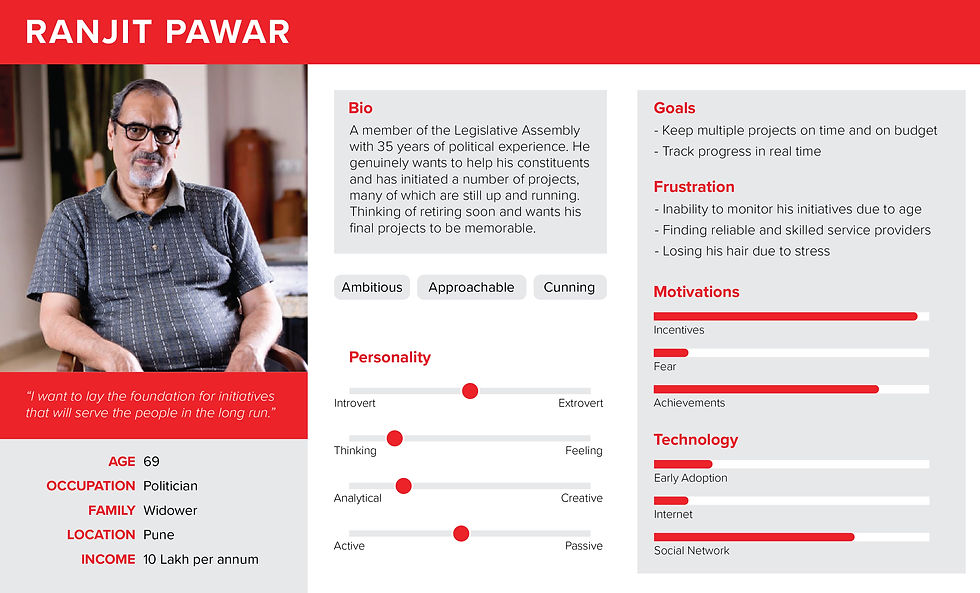
Once we decided to create a toolkit for setting up charging stations, we had to think about who can benefit from such a product. With that goal in mind, we used psycho-graphic segmentation to identify our prospective target audience and grouped them according to their interests, opinions, attitudes, values and overall behaviour. We came up with ten such segments and went on to create three personas, which are highly detailed, imaginary renditions of certain people from our chosen segments.


Visual Language

Ubuntu is a modern sans-serif, humanist-style typeface chosen for our Toolkit because of its clarity on desktop and mobile screens.
Ubuntu is an ancient African word that means compassion and highlights the sentiment 'I am because we are.' Since we built this Toolkit to empower an ordinary person to bring about change by setting up public charging station, it was fun to come across this fact and relate it to the overall intent behind this project.
We made sure to use a colour palette that would help us demarcate each section as a colour-coordinated whole. The choice of imagery was also carefully made, keeping in mind the Indian context so that the readers could better relate to the Toolkit. Images were sourced from open source city planning organisations and Government websites.
Interactive Map
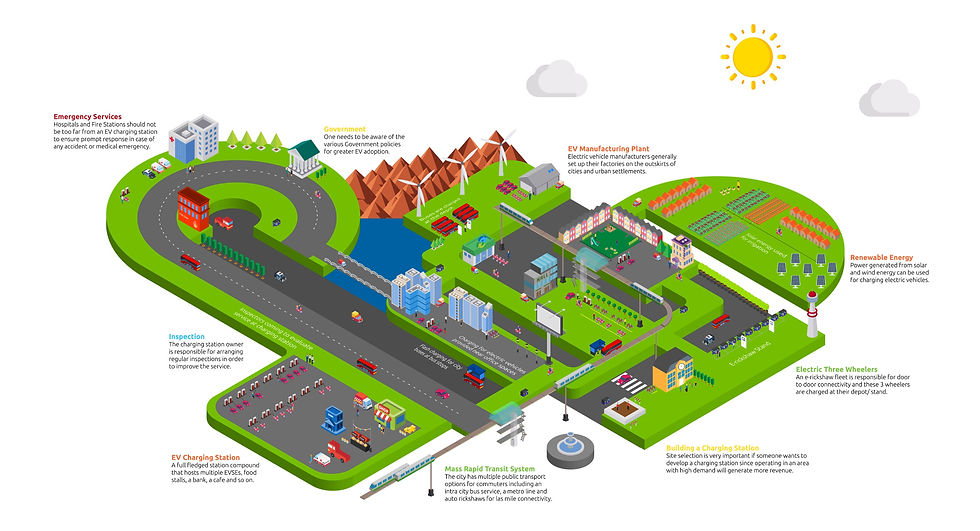
We designed this interactive map as a starting point of the reader's journey through our Toolkit. It not only helps interested readers to pick and choose relevant sections but also draws others to explore the context.


1. Hover over the area you are keen to know more about
3. Click on the link to open the section that interests you

2. Read the description and see if it is what you've been looking for
4. Let the learning begin!